
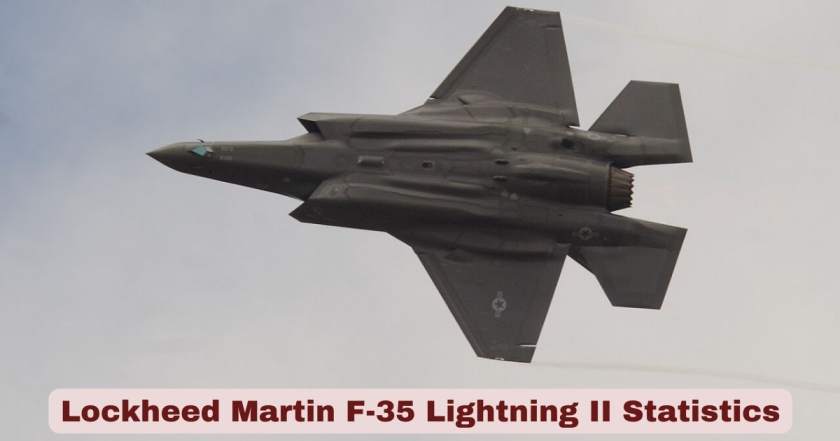
What Is Lockheed Martin F-35 Lightning II ?
The Lockheed Martin F-35 Lightning II is the most advanced, most widely produced, and most combat-tested fifth-generation stealth multirole strike fighter in the history of aviation — a single-seat, single-engine, supersonic aircraft that exists in three distinct variants, operates from conventional runways, aircraft carriers, and short austere airstrips, and has been acquired by 17 nations across North America, Europe, and the Indo-Pacific, making it the defining combat aircraft of the 21st century in a way no single platform has defined an era since the F-16 Fighting Falcon of the Cold War. Built by Lockheed Martin at its Fort Worth, Texas production facility — with principal partners Northrop Grumman (center fuselage, avionics) and BAE Systems (rear fuselage, aft section) — the F-35 began development under the Joint Strike Fighter program in the 1990s, achieved its first flight in December 2006, entered initial operational service with the U.S. Marine Corps in July 2015, and as of March 2026 has grown into a global fleet of approximately 1,300 aircraft delivered to operators across 12 countries. The three variants — the conventional takeoff and landing F-35A (USAF and most international operators), the short takeoff / vertical landing F-35B (USMC and UK Royal Air Force / Royal Navy), and the carrier variant F-35C (U.S. Navy and USMC) — share approximately 80% of common components despite their different capabilities, allowing a single sustainment and training infrastructure to support what is in effect three different operational aircraft. Every F-35 is equipped with the AN/APG-81 active electronically scanned array (AESA) fire control radar — 1,676 transmit/receive modules in a solid-state array with no moving parts — designed by Northrop Grumman with electronic warfare, synthetic aperture radar mapping, moving target tracking, and jamming capabilities fully integrated into a single aperture. The aircraft’s Distributed Aperture System (DAS) — six infrared cameras mounted symmetrically around the fuselage — provides the pilot with 360-degree spherical situational awareness displayed in the helmet visor, replacing the canopy frame and the pilot’s own body as visibility limitations and making the F-35 the only production fighter in the world that allows its pilot to look through the aircraft itself. As of January 7, 2026, Lockheed Martin officially confirmed delivery of a record 191 F-35s in 2025 — nearly doubling the 110 delivered in 2024 and surpassing the previous record of 142 set in 2021 — at a production pace five times faster than any other allied fighter currently being built anywhere in the world.
In 2026, the F-35 Lightning II is no longer being evaluated as a future platform — it is writing combat history in real time across multiple simultaneous operations on multiple continents, against adversaries with some of the most sophisticated air defense systems ever deployed. U.S. Air Force F-35As from the 34th Expeditionary Fighter Squadron (388th Fighter Wing, Hill AFB, Utah) were confirmed as the first aircraft to penetrate Iranian airspace during Operation Midnight Hammer on June 22, 2025 — flying ahead of the B-2 Spirit bombers, suppressing Iran’s S-300 and Bavar-373 air defense systems with weapons, and remaining in Iranian airspace until the last B-2 had safely exited, without a single F-35 being targeted by Iranian defensive fire. On February 3, 2026, a VMFA-314 F-35C from USS Abraham Lincoln became the first fifth-generation stealth fighter to shoot down an Iranian military drone in the Arabian Sea — an Iranian Shahed-139 that was “aggressively approaching” the carrier with “unclear intent,” confirmed by CENTCOM, USNI News, Air & Space Forces Magazine, and DefenseScoop. On February 28, 2026, F-35As from the 48th Fighter Wing at RAF Lakenheath, Vermont Air National Guard F-35As, and VMFA-314 F-35Cs from Lincoln all participated in Operation Epic Fury strikes against Iran — conducting SEAD (Suppression of Enemy Air Defenses) against Iranian integrated air defense systems while Israeli F-35I Adirs flew alongside with reports of up to 670 IAF sorties including F-35Is. Dutch F-35As made NATO history in September 2025 by becoming the first F-35s to kinetically protect NATO airspace, shooting down Russian drones that violated Polish airspace. F-35As and F-35Cs participated in the Venezuela operation in January 2026. No production fighter aircraft — and no fifth-generation aircraft in any nation’s inventory — has compiled a combat record this broad, this recent, or this verified in this short a timeframe. 2026 is the year the F-35 Lightning II became the unquestioned combat backbone of Western air power — not by design or declaration, but by repeated, documented performance under fire.
F-35 Lightning II 2026 — Key Facts
| # | F-35 Lightning II Key Fact | Details |
|---|---|---|
| 1 | Global Fleet of ~1,300 Aircraft Across 12 Countries as of January 2026 | Lockheed Martin confirmed on January 7, 2026 that the F-35 global fleet stands at approximately 1,300 aircraft delivered across 12 countries — the largest fifth-generation fighter fleet in the world by an enormous margin |
| 2 | Record 191 F-35s Delivered in 2025 — Nearly Doubled 2024’s 110 | Lockheed Martin delivered a record 191 F-35 Lightning IIs in 2025 — surpassing the previous record of 142 (2021) and nearly doubling 2024’s 110 — the program’s most productive year in two decades of production |
| 3 | Production Pace 5× Faster Than Any Other Allied Fighter | Per Lockheed Martin’s official January 7, 2026 announcement, the F-35’s annual production rate is now running five times faster than any other allied fighter jet currently in production worldwide |
| 4 | VMFA-314 F-35C Shoots Down Iranian Shahed-139 Drone — February 3, 2026 | A VMFA-314 “Black Knights” F-35C from USS Abraham Lincoln shot down an Iranian Shahed-139 drone in the Arabian Sea on February 3, 2026 — confirmed by CENTCOM, USNI News, Air & Space Forces Magazine, and DefenseScoop — the aircraft’s first confirmed air-to-air kill against an Iranian military asset |
| 5 | F-35As First Into Iranian Airspace — Operation Midnight Hammer, June 22, 2025 | 34th EFS F-35As (388th FW, Hill AFB, Utah) were confirmed as the first aircraft to enter Iranian airspace in Operation Midnight Hammer — suppressing S-300 and Bavar-373 SAM sites while remaining undetected — “they were just unable to target us,” said the 34th EFS commander, Lt. Col. Aaron Osborne |
| 6 | Dutch F-35A First to Kinetically Defend NATO Airspace — September 2025 | In September 2025, Royal Netherlands Air Force (RNLAF) F-35As became the first F-35s to kinetically defend NATO airspace, shooting down Russian drones that violated Polish airspace during a large-scale Moscow strike on Ukraine |
| 7 | F-35I Adir — Up to 670 IAF Sorties in Operation Epic Fury, February 28, 2026 | Israeli F-35I Adir fighters flew in massive numbers during Operation Epic Fury on February 28, 2026, with reports of up to 670 IAF sorties including F-35Is striking Iranian missile systems, nuclear infrastructure, and air defense sites |
| 8 | $24 Billion Lots 18–19 Contract — Largest in Program History | In September 2025, the F-35 JPO and Lockheed Martin finalized the Lots 18–19 contract for up to 296 aircraft at $24 billion — the largest production contract in the F-35 program’s history |
| 9 | Over 1 Million Cumulative Flight Hours Reached March 2025 | The F-35 program passed one million cumulative flight hours in March 2025 — a milestone confirming the jet’s transition from developmental program to operational mainstay |
| 10 | Block 4 / TR-3 Upgrade Completed 2025 — Block 4 Delays Revised to 2029 | Lockheed Martin completed TR-3 (Technology Refresh 3) hardware and software delivery in 2025, enabling Block 4 advanced capabilities — though the GAO has noted full Block 4 completion is revised to 2029 earliest (was originally 2026) |
| 11 | US Air Force Operates 500+ F-35As — Largest Single F-35 Fleet on Earth | The U.S. Air Force operates over 500 F-35As — including active duty, training, and test aircraft — making it by far the largest single F-35 operator in the world, roughly double the next largest fleet |
| 12 | F-35A Unit Cost Down to ~$75–80 Million — from $220M+ in 2006 | The F-35A unit flyaway cost has fallen to approximately $75–80 million per aircraft in recent lots — down from over $220 million in 2006 — demonstrating the program’s successful cost reduction trajectory over 20 years of production |
| 13 | AN/APG-85 New AESA Radar — First Deliveries Late 2025 / Early 2026 | Northrop Grumman’s next-generation AN/APG-85 radar — Gallium Nitride-based, compatible with all F-35 variants — entered production with first deliveries anticipated in late 2025 / early 2026 for the last jets of Lot 17 and Block 4 aircraft |
| 14 | F-35A Carries B61-12 Nuclear Bomb Under NATO Nuclear Sharing | The F-35A is the NATO-certified nuclear delivery aircraft for the alliance’s dual-key nuclear sharing arrangements — replacing the F-16 at bases in the Netherlands, Belgium, Germany, Italy, and Turkey with full stealth delivery capability of the B61-12 gravity bomb |
| 15 | 17 Nations Have Ordered F-35 — Canada’s First 4 Deliver in 2026 | 17 nations have signed F-35 orders, with Canada receiving its first 4 aircraft in 2026 (of 88 total ordered for $CA19 billion); Italy added 25 aircraft and Denmark added 16 to their programs of record in 2025 |
Source: Lockheed Martin official press release (news.lockheedmartin.com / f35.com, January 7, 2026); USNI News (news.usni.org, February 3, 2026); DefenseScoop (defensescoop.com, February 3, 2026); Air & Space Forces Magazine (airandspaceforces.com, February 3 and February 28, 2026); CENTCOM official statement (centcom.mil, February 3, 2026); The Aviationist (theaviationist.com, January 9, 2026); Simple Flying (simpleflying.com, January 2026); Army Recognition (armyrecognition.com, January 2026); Janes (janes.com, January 12, 2026); Wikipedia – F-35 Lightning II (updated March 2, 2026); Wikipedia – VMFA-314 (updated March 2026); IBTimes (ibtimes.com, March 4, 2026); Air & Space Forces Magazine – APG-85 radar (airandspaceforces.com); The World Data (theworlddata.com, March 2026); DVIDSHUB (dvidshub.net)
These 15 F-35 Lightning II key facts for 2026 define a program that has completed its transformation from the most controversial, most expensive, and most delayed defense acquisition in U.S. history into the undisputed backbone of Western air power — validated not in exercises or capability briefings, but in repeated documented combat against a nation that operates S-300 and Bavar-373 air defense systems, that fired hundreds of ballistic missiles and drones in retaliation, and that was still unable to detect, track, or target a single F-35 during any of these engagements. The 34th EFS commander’s words from Operation Midnight Hammer — “they were just unable to target us” — are the seven-word summary of every billion dollars spent developing the aircraft’s low-observable design. The gap between the $220 million unit cost in 2006 and the $75–80 million unit cost in recent production lots is the measure of how 20 years of production ramp and learning curve have made the most capable fighter ever built also an economically competitive one relative to the fourth-generation aircraft it replaces.
The five-fold production rate advantage over any other allied fighter is the strategic-industrial data point that matters most for the long-term balance of air power among potential adversaries. China’s J-20 production rate is estimated at perhaps 50–75 aircraft per year; Russia’s Su-57 is in the low single digits annually. The F-35’s stable production rate of 156+ per year — with the Lots 18–19 contract covering 296 more aircraft and Lockheed stating it expects sustained long-term production driven by continued international orders — means the Western fifth-generation fleet will continue to grow at a pace that no near-peer adversary can match. The $24 billion Lots 18–19 contract alone will deliver more F-35s than China has ever produced of any single fifth-generation aircraft type. The 17-nation customer base — which includes NATO’s most capable air forces, Japan, South Korea, Australia, Israel, and Singapore — means that F-35 production, sustainment, and capability development is underpinned by an international industrial and political coalition that makes the program essentially irreversible at this scale.
F-35 Lightning II 2026 — Technical Specifications (All Three Variants)
| Specification | F-35A (CTOL) | F-35B (STOVL) | F-35C (CV) |
|---|---|---|---|
| Variant Full Name | Conventional Takeoff & Landing | Short Takeoff / Vertical Landing | Carrier Variant |
| Primary Operators | USAF, most international air forces | USMC, UK RAF / Royal Navy | US Navy, USMC |
| Engine | Pratt & Whitney F135-PW-100 | F135-PW-600 + Rolls-Royce LiftFan | F135-PW-400 |
| Engine Thrust (with afterburner) | 43,000 lbf (191 kN) | 43,000 lbf + 20,000 lbf lift fan | 43,000 lbf |
| Length | 51.4 ft (15.7 m) | 51.2 ft (15.6 m) | 51.5 ft (15.7 m) |
| Wingspan | 35 ft (10.7 m) | 35 ft (10.7 m) | 43 ft (13.1 m) — larger for lift |
| Empty Weight | 29,300 lb (13,290 kg) | 32,300 lb (14,651 kg) | 34,800 lb (15,785 kg) |
| Max Takeoff Weight | 70,000 lb (31,751 kg) | 60,000 lb (27,215 kg) | 70,000 lb (31,751 kg) |
| Max Speed | Mach 1.6 (1,200 mph / 1,930 km/h) | Mach 1.6 | Mach 1.6 |
| Combat Radius (internal fuel) | ~590 nm (1,093 km) | ~450 nm (833 km) | ~615 nm (~1,140 km) |
| Service Ceiling | 50,000+ ft (15,240+ m) | 50,000+ ft | 50,000+ ft |
| Internal Weapons Payload | 5,700 lb (2,585 kg) | ~3,000 lb | 5,700 lb (2,585 kg) |
| External Weapons Payload | 18,000+ lb total (external + internal) | 15,000+ lb total | 18,000+ lb total |
| Internal Weapon Bays | 2 bays — up to 4 × AIM-120 AMRAAM + 2 × GBU-31 JDAM (2,000 lb) | 1 bay — 2 × AIM-120 + 2 × 500 lb GBU-12 | 2 bays — 4 × AIM-120 AMRAAM + 2 × GBU-31 |
| Internal Gun | 1 × GAU-22/A 25mm 4-barrel Gatling (internal) | 1 × GAU-22/A (in centerline pod) | No internal gun (external pod option) |
| Primary Radar | AN/APG-81 AESA (1,676 T/R modules) | AN/APG-81 | AN/APG-81 |
| Next-Gen Radar | AN/APG-85 (Block 4, late 2025/2026 introduction) | AN/APG-85 | AN/APG-85 |
| EW System | AN/ASQ-239 Barracuda EW suite | AN/ASQ-239 | AN/ASQ-239 |
| Distributed Aperture System | AN/AAQ-37 DAS — 6 × IR cameras, 360° SA | AN/AAQ-37 DAS | AN/AAQ-37 DAS |
| EOTS | AN/AAQ-40 Electro-Optical Targeting System | AN/AAQ-40 EOTS | AN/AAQ-40 EOTS |
| Datalinks | MADL + Link 16 + CDL | MADL + Link 16 | MADL + Link 16 |
| Helmet | Striker II Helmet-Mounted Display System | Striker II HMDS | Striker II HMDS |
| Carrier Compatibility | Not carrier-capable | STOVL only — LHA / LHD | CATOBAR — all US Navy supercarriers |
| Unit Cost (FY2024 lots) | ~$75–80 million | ~$101 million | ~$107 million |
| Nuclear Delivery | B61-12 nuclear gravity bomb (NATO nuclear sharing) | No | No |
Source: Lockheed Martin F-35 official website (f35.com); U.S. Air Force Fact Sheet – F-35A (af.mil); NAVAIR F-35C product page (navair.navy.mil); Army Recognition – F-35C USS Abraham Lincoln (armyrecognition.com, February 2026); Wikipedia – F-35 Lightning II (updated March 2026); Northrop Grumman – AN/APG-81 (northropgrumman.com); Air & Space Forces Magazine – APG-85 radar (airandspaceforces.com); TheDefenseWatch (thedefensewatch.com)
The F-35 Lightning II three-variant technical specifications reveal the remarkable engineering achievement of building three fundamentally different aircraft around an 80% common airframe, systems, and production infrastructure. The F-35B’s Rolls-Royce LiftFan — a shaft-driven, clutch-engaged vertical lift device generating 20,000 additional pounds of vertical thrust combined with a rotating exhaust nozzle from the F135 main engine — is one of the most mechanically complex propulsion systems ever installed in a production fighter aircraft, and the weight and volume it requires account for the B’s slightly smaller weapons bay and combat radius compared to the A and C variants. The F-35C’s 43-foot wingspan — 8 feet wider than the A and B — and its reinforced landing gear and enlarged tail hook represent the structural demands of arrested landings on a carrier deck, where deceleration forces can reach 3–4 g in a fraction of a second. The fact that the same core avionics suite — APG-81, AN/AAQ-37 DAS, EOTS, ASQ-239, Striker II HMDS — is common to all three variants is the engineering decision that makes the entire program’s economics work: a single radar production line, a single helmet system, a single EW suite, maintained and upgraded once and deployed across the entire global F-35 fleet of 1,300+ aircraft in 12 countries.
The AN/APG-81’s 1,676 transmit/receive modules are the technical heart of everything the F-35 does in contested airspace. Unlike mechanical-scan radars — which move a physical dish to steer the beam — the APG-81’s AESA design steers the radar beam electronically at the speed of light, enabling the radar to simultaneously support air-to-air target tracking, air-to-ground synthetic aperture mapping, moving target indication, electronic jamming, and electronic support measures without switching modes or mechanically repositioning. Northrop Grumman’s production cost reduction of over 70% across 11 lots confirms that AESA technology — initially exclusive to premium platforms like the F-22 — has now been fully commoditized into a production-scale defense industrial process. The introduction of the AN/APG-85 for Block 4 aircraft — a Gallium Nitride-based system that Air & Space Forces Magazine describes as incorporating “some of the latest technologies available” with first deliveries anticipated late 2025 / early 2026 — extends the F-35’s radar technology leadership into the next decade, with GaN devices offering substantially higher power density and efficiency than the silicon-based T/R modules of the APG-81.
F-35 Lightning II 2026 — Production Statistics & Annual Deliveries
| Year | F-35 Deliveries | Notable Events |
|---|---|---|
| 2015 | ~45 | USMC F-35B achieves IOC (July 2015) — first F-35 operational service |
| 2016 | ~46 | USAF F-35A achieves IOC (August 2016) |
| 2017 | ~66 | Production ramp begins |
| 2018 | ~91 | International deliveries accelerating |
| 2019 | ~134 | USN F-35C achieves IOC (February 2019) |
| 2020 | ~123 | COVID impacts; program continues |
| 2021 | 142 | Previous delivery record (prior to 2025) |
| 2022 | 141 | Steady high-volume production |
| 2023 | 98 | Sharp decline — TR-3 issues halt deliveries July 2023 |
| 2024 | 110 | Partial recovery — TR-3 backlog clearing; deliveries restart July 2024 |
| 2025 | 191 ✦ | New all-time record — TR-3 backlog cleared; 5× faster than any allied fighter |
| Stable Production Rate (from 2025) | 156+ per year | Lockheed confirmed stable forward production rate |
| Total Delivered (end 2025) | ~1,300 | Global fleet across 12 countries |
| Lots 18–19 Contract (Sep 2025) | Up to 296 aircraft | $24 billion — largest contract in program history |
| US Program of Record Total | ~2,456 aircraft (USAF: 1,763; USMC: 353; USN: 273 + extras) | Total planned US procurement |
| Total Global Orders | ~3,300+ aircraft (all nations combined) | All 17 customer nations total |
Source: Lockheed Martin official press release (f35.com / news.lockheedmartin.com, January 7, 2026); The Aviationist (theaviationist.com, January 9, 2026); Simple Flying (simpleflying.com, January 2026); Janes (janes.com, January 12, 2026); Wikipedia – F-35 Lightning II (updated March 2026); GAO-24-106703 (gao.gov, 2024)
The F-35 production statistics across 2015–2025 tell the full story of a program that endured the most damaging developmental setback in its post-IOC history — the TR-3 delivery halt from July 2023 to July 2024 — and responded with the most productive single year in its existence. The drop from 141 deliveries in 2022 to just 98 in 2023 was directly caused by software development problems with Technology Refresh 3, the hardware upgrade enabling Block 4 advanced capabilities. TR-3 issues caused 72–110 completed aircraft to be stored at Lockheed’s Fort Worth facility, unable to be delivered, as the Joint Program Office withheld acceptance pending software resolution. The recovery in 2024 to 110 deliveries began the backlog clearance; the 191-aircraft record of 2025 reflects both the cleared backlog and what Lockheed describes as a stable forward production rate of 156+ aircraft per year. The distinction matters: the 2025 record was partly elevated by backlog clearance, and 2026 deliveries will likely be somewhat lower as Lockheed transitions to its stable rate — but 156+ per year is itself a number larger than any prior year except 2021, 2022, and 2025.
The $24 billion Lots 18–19 contract finalized in September 2025 — covering up to 296 aircraft for the U.S. and international customers — gives the program financial and production visibility through the late 2020s. Lockheed’s CFO Evan Scott stated during the Q3 2025 earnings call that “steady demand from international allies gives us confidence in sustained long-term production” — a statement backed by Italy’s 25-aircraft addition, Denmark’s 16-aircraft addition, and Canada receiving its first 4 of 88 aircraft in 2026. The U.S. program of record of ~2,456 aircraft means the U.S. alone has enough planned procurement to sustain production at current rates for more than 15 years beyond the aircraft already delivered — and international orders of ~3,300+ total across all 17 customer nations make this the most extensive fighter procurement program in history.
F-35 Lightning II 2026 — Combat Record Statistics
| Operation / Event | Date | Variant | Unit | Role / Action | Outcome / Significance |
|---|---|---|---|---|---|
| First combat use — Operation Inherent Resolve (Syria) | September 2018 | F-35B | USMC | Ground attack — Syrian targets | First F-35 in combat; B variant |
| Operation Rough Rider — Houthi strikes, Yemen | 2024–2025 | F-35A / F-35C | USAF 388th FW; USMC | Strike operations against Houthi targets | Extensive combat deployment; first sustained F-35 carrier combat cycle |
| First F-35A air-to-air kills — Houthi drones, Yemen | 2024–2025 | F-35A | 34th EFS / 388th FW, Hill AFB | Shot down Houthi one-way attack drones over Yemen | First air-to-air kills by any F-35A variant — historic program milestone |
| Operation Midnight Hammer — Iran nuclear sites | June 22, 2025 | F-35A | 34th EFS, 388th FW, Hill AFB, Utah | SEAD — first aircraft into Iranian airspace; destroyed S-300 and Bavar-373 SAM sites | “They were just unable to target us” — Lt. Col. Aaron Osborne, 34th EFS; no F-35 targeted; first fifth-gen combat in Iranian airspace |
| NATO airspace defense — Russian drones over Poland | September 9–10, 2025 | F-35A | Royal Netherlands Air Force (RNLAF) | Kinetic intercept of Russian drones violating Polish airspace | First F-35 kinetic action in NATO airspace defense — RNLAF aircraft with drone kill marking confirmed |
| Venezuela Operation — capture of Maduro | January 2026 | F-35A | USAF (48th FW and others) | SEAD — disabled Venezuelan air defense systems | Enabled helicopter operations; General Dan Caine confirmed F-35 role |
| F-35C vs Iranian Shahed-139 — USS Abraham Lincoln | February 3, 2026 | F-35C | VMFA-314 “Black Knights,” CVW-9, USS Abraham Lincoln | Shot down Iranian Shahed-139 surveillance drone in self-defense — 500 miles from Iran’s coast | Confirmed by CENTCOM, USNI News, Air & Space Forces Magazine — first F-35C kill of Iranian military asset |
| Operation Epic Fury — US F-35s | February 28, 2026 | F-35A + F-35C | 48th FW RAF Lakenheath, Vermont ANG, VMFA-314 / USS Lincoln | Strikes and SEAD against Iran — 100+ aircraft first wave | F-35As from Lakenheath and Vermont ANG + VMFA-314 F-35Cs from Lincoln confirmed by IBTimes and DVIDSHUB official imagery |
| Operation Epic Fury — Israeli F-35I Adir | February 28, 2026 | F-35I Adir | Israeli Air Force (IAF) | Up to 670 IAF sorties including F-35Is — Iranian missile systems, nuclear sites, air defense, leadership | Largest known single-day F-35 combat operation by any nation; IAF “refused to enter Iranian airspace without F-35s leading” per JINSA December 2025 |
Source: The World Data – F-35 Statistics 2026 (theworlddata.com, March 2, 2026); Wikipedia – VMFA-314 (updated March 2026); USNI News (news.usni.org, February 3, 2026); DefenseScoop (defensescoop.com, February 3, 2026); CENTCOM (centcom.mil, February 3, 2026); Air & Space Forces Magazine (airandspaceforces.com, February 3 and February 28, 2026); IBTimes (ibtimes.com, March 4, 2026); DVIDSHUB (dvidshub.net, March 2026); The Aviationist (theaviationist.com, January 9, 2026); Wikipedia – F-35 Lightning II (updated March 2026)
The F-35 Lightning II combat record statistics for 2025–2026 constitute the most operationally rich real-world validation dataset in the history of fifth-generation fighter development. Every major claim made by the F-35’s designers and developers during the program’s long and contentious acquisition history — that the aircraft’s stealth would defeat advanced integrated air defense systems, that its sensor fusion would give pilots decisive situational awareness advantages, that its ability to operate as a “flying sensor node” would multiply the effectiveness of the entire force package — has now been tested and confirmed against actual adversary systems in actual combat. The Iranian S-300 and Bavar-373 air defense systems are not simulated range threats: they are among the most capable non-Russian-operated integrated air defenses in the world, with long-range surveillance radars, multiple engagement radars, and sophisticated command-and-control networks. The 34th EFS going in first on June 22, 2025, destroying those systems while remaining undetected, and the JINSA December 2025 report that Israeli leadership “refused to enter Iranian airspace without F-35s leading” — these are the authoritative operational verdicts on the platform’s core design premise.
The VMFA-314 F-35C shootdown of the Iranian Shahed-139 on February 3, 2026 deserves examination beyond its tactical significance. The Shahed-139 is a medium-altitude, long-endurance (MALE) drone — visually similar to an MQ-1 Predator — with a cruise speed of approximately 185 km/h. An F-35C is a Mach 1.6 supersonic fighter. The engagement required the F-35 to locate, identify, intercept, and destroy a slow-moving, low-signature target in the open ocean — a mission profile very different from the supersonic maneuvering air-to-air engagement or high-speed ground attack profiles the aircraft was primarily designed for. The F-35’s 360-degree DAS, AN/APG-81 air-to-air modes, and AIM-9X or AIM-120 weapons compatibility made the mission execution routine. CENTCOM did not specify what weapon was used, but the F-35C’s available options — AIM-9X Sidewinder, AIM-120 AMRAAM, or 25mm gun pod — all represent different points on the cost-per-kill spectrum against a slow drone target. The broader operational lesson: the F-35’s sensor and weapons suite makes it a universally capable air threat responder from hypersonic cruise missiles at 50,000 feet to slow surveillance drones 50 feet above the wave tops.
F-35 Lightning II 2026 — Global Operators & Fleet Statistics
| Nation | Variant(s) | Aircraft Delivered / Ordered (2026) | Status |
|---|---|---|---|
| United States (USAF) | F-35A | 500+ active (439 operational F-35As per USAF; 500+ including test/training) | Active — world’s largest F-35 fleet; Operation Epic Fury, Venezuela Jan 2026 |
| United States (USMC) | F-35B + F-35C | On track for 261 by end 2026 (USMC 2026 Aviation Plan) | VMFA-314 F-35Cs active on USS Abraham Lincoln — combat-proven Feb 3 + Epic Fury |
| United States (USN) | F-35C | 100+ delivered; 273 total program of record | Active — carrier deployments |
| Israel | F-35I Adir | ~75 aircraft (50 F-35I Batch 1 + 25 F-35I Batch 2) | Most combat-experienced F-35 operator globally — Operation Midnight Hammer June 2025; ~670 Epic Fury sorties Feb 28, 2026 |
| United Kingdom | F-35B | ~47 delivered of 138 ordered | Active — RAF and Royal Navy; HMS Queen Elizabeth deployments |
| Netherlands | F-35A | ~46 delivered of 52 ordered | Completed transition from F-16; first NATO F-35 air-to-air kill (Russian drone, Sep 2025) |
| Norway | F-35A | 52 aircraft — fleet complete | Norway completed all F-35A deliveries in 2025 |
| Australia | F-35A | ~72 delivered of 72 total order | Fleet delivery completed; RAAF fully operational |
| Italy | F-35A + F-35B | ~60+ delivered; added 25 more in 2025 | Active — expanded program of record in 2025 |
| Japan | F-35A + F-35B | ~100+ delivered of 147 total order; first 3 F-35Bs at Nyutabaru (Aug 2025) | IOC declared 2019; F-35Bs for Izumo-class carriers; 4 more F-35Bs due by March 2026 |
| South Korea | F-35A | ~60 delivered of 60 total | Full delivery complete; active ROKAF service |
| Denmark | F-35A | ~27 delivered; added 16 more in 2025 | Deactivated all F-16s; fully transitioned to F-35 |
| Belgium | F-35A | First aircraft arrived in-country 2025 | Belgium welcomed first domestic-based F-35s in 2025 |
| Finland | F-35A | First F-35A rollout December 8, 2025 | Finland’s first F-35A maiden flight December 8, 2025 |
| Singapore | F-35B | 8 delivered (of up to 12 total) | First F-35B operator in Southeast Asia |
| Poland | F-35A | 32 ordered — deliveries pending | Contract signed; delivery schedule in progress |
| Canada | F-35A | 4 delivered in 2026 (of 88 total; $CA19B contract) | First 4 delivered 2026 per official schedule; program under political review |
| Total Nations | All variants | 17 customer nations | Global operator coalition continuously expanding |
Source: Lockheed Martin (f35.com / news.lockheedmartin.com, January 7, 2026); Army Recognition (armyrecognition.com); Wikipedia – F-35 Lightning II (updated March 2026); USMC 2026 Aviation Plan (marines.mil, February 2026); IBTimes (ibtimes.com, March 4, 2026); Simple Flying (simpleflying.com, January 2026); Janes (janes.com, January 12, 2026); The Aviationist (theaviationist.com, January 9, 2026)
The F-35 global operator statistics for 2026 reveal the full strategic scope of what Lockheed Martin’s CFO called “the most expansive and strategically embedded fighter initiative of the 21st century.” The 17-nation customer base is not merely a commercial success metric — it is a strategic architecture. Every nation operating F-35s shares the same MADL datalink that allows real-time sensor fusion across all F-35 aircraft in a formation regardless of national origin; every F-35 pilot trains in the same Distributed Mission Operations network; every F-35 fleet is sustained by the same global supply chain under the Air Vehicle Sustainment Contract finalized in 2025. The Netherlands and Norway completing their F-16-to-F-35 transitions and Denmark deactivating all its F-16s are the clearest statements available from NATO allies that the F-35 is not a supplementary capability but a wholesale generational replacement of the previous-generation fighter fleet. The fact that Israel — the most combat-experienced F-35 operator in the world — flew up to 670 sorties in a single day on February 28, 2026, is the operational proof that the aircraft can sustain the sortie generation tempo of a high-intensity major air campaign, not just demonstrate capability in carefully managed low-intensity deployments.
Japan’s F-35B program — with the first three aircraft landing at Nyutabaru Air Base in August 2025 and four more due by March 2026, ultimately destined for deployment aboard Izumo-class “helicopter destroyers” converted to light carrier capability — represents the most consequential Indo-Pacific F-35 development of 2025–2026. Japan will become the first nation outside the U.S. to deploy F-35Bs from modified destroyer-class ships, giving the Japan Maritime Self-Defense Force a carrier-borne fifth-generation strike capability that fundamentally changes the regional air power balance in the Western Pacific. Finland’s first F-35A maiden flight on December 8, 2025 marks the northernmost expansion of the F-35 coalition, giving NATO a fifth-generation presence at 60–70 degrees north latitude directly adjacent to Russian airspace — a strategic basing geography that changes the calculus of any potential Nordic conflict scenario. The 17-nation F-35 coalition is, in geopolitical terms, the most powerful peacetime air combat alliance ever assembled around a single platform.
Disclaimer: The data reports published on The Global Files are sourced from publicly available materials considered reliable. While efforts are made to ensure accuracy, no guarantees are provided regarding completeness or reliability. The Global Files is not liable for any errors, omissions, or damages resulting from the use of these reports.