
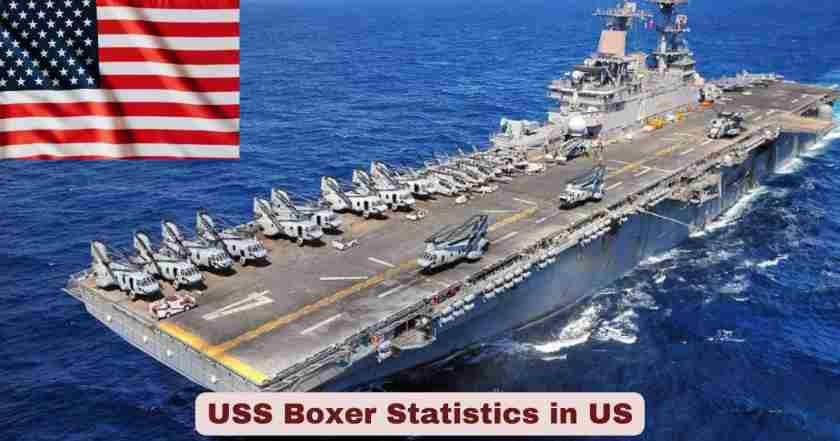
USS Boxer in America 2026
The USS Boxer (LHD-4) is a Wasp-class amphibious assault ship of the United States Navy — a 843-foot-long, 40,500-ton warship that serves simultaneously as a Marine troop carrier, a flight deck for helicopter and fixed-wing aviation, an amphibious assault platform, and in its most potent configuration, a “Lightning Carrier” capable of operating F-35B stealth strike-fighters. Commissioned on February 11, 1995 at Ingalls Shipbuilding in Pascagoula, Mississippi, the USS Boxer is the fourth ship in the Wasp class and the sixth U.S. Navy vessel to bear the Boxer name — a lineage that traces directly to the original HMS Boxer, a British brig captured by the U.S. Navy during the War of 1812. Homeported at Naval Base San Diego, California, the ship operates under the command of Commander, Naval Surface Force Pacific (SURFPAC) and serves as the flagship of the Boxer Amphibious Ready Group (ARG), which in 2026 includes USS Comstock (LSD-45) and USS Portland (LPD-27). Its motto — “Honor, Courage, Strength” — reflects the core values the ship and its crew have embodied across nearly 30 years of deployments spanning anti-piracy operations off Somalia, combat strikes against ISIS in Iraq and Syria, drone intercept in the Strait of Hormuz, and humanitarian missions across the Pacific. After years of complex maintenance challenges following a massive $200.3 million F-35B modernization overhaul begun in 2020, the USS Boxer has returned to full operational service and in March 2026 is deploying ahead of schedule to the Middle East in support of one of the most significant U.S. military operations in a generation.
As of March 21, 2026 — today — the USS Boxer is at sea, having departed San Diego on March 18, 2026, just five days after a change of command ceremony that transferred command to Captain Eli Owre on March 13, 2026. The accelerated departure, confirmed by four anonymous defense officials cited by Newsmax and corroborated by NBC News, USNI News, Reuters, and Military Times, sends the Boxer ARG with the 11th Marine Expeditionary Unit (MEU) — approximately 2,200 Marines from Camp Pendleton, California — toward the Middle East in support of Operation Epic Fury, the ongoing U.S.-Israeli military campaign against Iran that began on February 28, 2026. The deployment joins the already-underway USS Tripoli (LHA-7) ARG and its 31st MEU elements, together adding roughly 8,000 additional Marines and sailors to the American force posture in the region. Together, these six amphibious ships represent the most concentrated deployment of U.S. amphibious power to the Middle East since Operation Iraqi Freedom in 2003 — and the USS Boxer is at the center of it, deploying just two years after a prolonged maintenance ordeal that at one point left the ship unable to leave port. The ship’s return to operational prominence in 2026 is one of the most dramatic turnaround stories in recent U.S. Navy history.
USS Boxer Key Facts in the US 2026
| Fact Category | Key Fact / Data Point |
|---|---|
| Hull Number and Designation | LHD-4 — Landing Helicopter Dock, Hull 4 of the Wasp Class |
| Ship Class | Wasp-class amphibious assault ship — fourth of eight ships built |
| Namesake Lineage | Sixth U.S. Navy vessel named “Boxer” — original HMS Boxer captured by U.S. Navy, War of 1812 |
| Ship’s Motto | “Honor, Courage, Strength” |
| Builder | Ingalls Shipbuilding, Pascagoula, Mississippi |
| Contract Awarded | October 3, 1988 |
| Keel Laid | April 18, 1991 |
| Launched | August 13, 1993 |
| Christened | August 28, 1993 — by sponsor Becky Miller |
| Commissioned | February 11, 1995 — in San Diego, California |
| Years in Active Service (March 2026) | 31 years — commissioned February 1995 |
| 30th Commissioning Anniversary | February 11, 2025 — marked as milestone during Third Fleet operations |
| Ship Identification | MMSI: 368710000; Call Sign: NBXR |
| Current Homeport (2026) | Naval Base San Diego (NBSD), California |
| Current Status (March 21, 2026) | At sea — departed San Diego March 18, 2026 — en route Middle East, Operation Epic Fury |
| Current Commanding Officer (2026) | Captain Eli Owre — assumed command March 13, 2026 at change of command ceremony |
| Prior Commanding Officer | Captain Jason Tumlinson — relieved March 13, 2026 |
| ARG Companion Ships (2026) | USS Portland (LPD-27) and USS Comstock (LSD-45) |
| Embarked Unit (2026) | 11th Marine Expeditionary Unit (MEU) — ~2,200 Marines, Camp Pendleton, California |
| Total Amphibious Force Personnel (2026 Deployment) | Approximately 4,000 combined — sailors and Marines across the three Boxer ARG ships |
| Battle “E” Awards Total | 14 Battle “E” Efficiency Awards — 1995, 1998, 1999, 2001, 2003, 2007, 2011, 2012, 2013, 2014, 2015, 2016, 2017, and others |
| F-35B Certified Status (2026) | Yes — fully certified following $200.3M BAE Systems overhaul (2020–2023) |
| Marjorie Sterrett Battleship Fund Award | Won 2003 — Pacific Fleet excellence award |
Source: U.S. Navy Official Ship Page, surfpac.navy.mil; Wikipedia USS Boxer (LHD-4), updated March 21, 2026; DVIDS USS Boxer Unit Page (dvidshub.net); USNI News March 20, 2026; NBC 7 San Diego March 20, 2026; Fox 5 San Diego March 19, 2026
The USS Boxer’s 31-year service record as of March 2026 stands as one of the longer active service runs in the Wasp class and reflects a ship that has been continuously modernized to remain relevant to evolving naval requirements. The 14 Battle “E” Efficiency Awards — the Navy’s highest award for sustained operational excellence — represent a remarkable streak that spans nearly every decade of the ship’s service life, recognizing not just moments of exceptional performance but consistent, high-level readiness maintained year after year across multiple commanding officers, crew rotations, and deployment cycles. The award in 1995 — the very first year of commissioning — set the tone immediately: this was not a ship that needed time to find its footing. That culture of operational discipline, embedded at commissioning and reinforced through deployments to the Persian Gulf, the Pacific, the Indian Ocean, and now again to the Middle East in 2026, is what makes the USS Boxer’s return from its extended maintenance period so significant. A lesser institutional culture might have degraded during the years the ship spent in and out of the shipyard. The Boxer’s 14 Battle “E” record suggests it did not.
The change of command ceremony on March 13, 2026 — just five days before the accelerated departure for the Middle East — captures the extraordinary operational tempo the Navy is maintaining in 2026. Captain Eli Owre assumed command of one of the Navy’s most complex warships and was at sea in the Pacific within a week, heading into one of the most operationally demanding theaters in the world. The DVIDS photographic record from the weeks leading up to departure tells the story in granular detail: Marines of Battalion Landing Team 3/5, 11th MEU conducting fast-rope drills from MV-22B Ospreys off the California coast on February 25; Maritime Raid Force Marines rehearsing assault techniques on February 25; replenishment-at-sea operations with USNS oilers on February 27; and hull maintenance welding underway on February 26 — all happening simultaneously on an operational ship that completed its certification exercises and was ready to sail on 48 hours’ notice.
USS Boxer Technical Specifications Statistics in the US 2026
| Technical Parameter | Specification / Data |
|---|---|
| Ship Type | Wasp-class Landing Helicopter Dock (LHD) — multipurpose amphibious assault ship |
| Full-Load Displacement | 40,500 long tons (41,150 metric tons) |
| Length | 843 feet (257 meters) |
| Beam (Width) | 104 feet (31.8 meters) |
| Draft | 27 feet (8.1 meters) |
| Propulsion | Two boilers, two geared steam turbines, two shafts — 70,000 shaft horsepower (52,000 kW) |
| Maximum Speed | 22 knots (25 mph / 41 km/h) |
| Range | 9,500 nautical miles (17,600 km) at 18 knots |
| Well Deck Dimensions | 266 ft × 50 ft × 28 ft high (81 m × 15.2 m × 8.5 m) |
| Flight Deck Size | Approximately 819 ft × 112 ft — the full width of the ship |
| Helicopter Landing Spots | 9 helicopter spots on flight deck |
| Aircraft Elevators | Two deck-edge elevators, foldable for Panama Canal transit |
| Ship’s Crew (Complement) | 1,208 total — (98 officers + 1,110 enlisted sailors) |
| Marine Detachment Capacity | 1,687 troops standard + 184 surge = up to 1,871 Marines |
| Combined Total Aboard (Combat Load) | Approximately 3,000–3,200 sailors and Marines combined |
| Hospital Beds (Standard) | 64 patient beds + 6 operating rooms |
| Hospital Beds (Overflow Surge) | Expandable to 600 beds in mass-casualty configuration |
| Freshwater Production | Up to 200,000 gallons per day from onboard distilling plants |
| Drydock Used for Overhaul | BAE Systems “Pride of California” drydock — San Diego — 950 feet long |
| Panama Canal Compatibility | Yes — bridge wings and elevator arms fold to clear Canal lock walls (despite bridge wing damage on first transit, 1995) |
| CIWS Mounts | Three 20mm Phalanx CIWS systems — one more than most Wasp-class ships |
Source: U.S. Navy Fact Files, Navy.mil; Wikipedia Wasp-class Amphibious Assault Ship; BAE Systems press release 2020; Army Recognition.com; navysite.de USS Boxer specifications page; Federation of American Scientists, fas.org
The USS Boxer’s physical dimensions share the same Wasp-class baseline — 843 feet and 40,500 tons — as its seven sister ships, but there are meaningful equipment differences that set specific ships apart within the class. The Boxer carries three 20mm Phalanx CIWS systems — one more than many of its sisters — and four 25mm Mk 38 chain guns alongside its missile systems, giving it a slightly denser close-in defensive armament. The well deck — measuring 266 feet long, 50 feet wide, and 28 feet high — is the ship’s amphibious heart, capable of simultaneously housing and deploying up to three Landing Craft Air Cushion (LCAC) hovercraft or two Landing Craft Utility (LCU) vessels or 12 Landing Craft Mechanized (LCM) — the choice of which depends entirely on the mission profile. An LCAC can approach a hostile beach at 40+ knots and land Marines and vehicles on 70% of the world’s coastlines (compared to only 17% accessible to conventional displacement landing craft), making it the preferred assault option when speed and beach gradient are critical variables.
The steam propulsion plant — two boilers driving two geared steam turbines at a combined 70,000 shaft horsepower — is both a heritage characteristic and an operational reality that defines the USS Boxer’s maintenance requirements. Steam propulsion demands more personnel to operate and maintain than the gas turbine systems used on USS Makin Island (LHD-8), the last and most modern ship of the Wasp class. This propulsion type requires careful management of boiler chemistry, steam pressure, and turbine condition — a technical discipline that is becoming increasingly rare in the Navy as gas turbine and electric drive systems proliferate. The BAE Systems “Pride of California” drydock in San Diego — at 950 feet long, purpose-built to accommodate large-deck amphibious ships — was used for the first time on a big-deck warship specifically for the Boxer’s 2020–2023 overhaul, allowing comprehensive access to the hull, tanks, and running gear that would have been impossible in a wet berth. The freshwater production capacity of 200,000 gallons per day makes the ship fully self-sustaining for its crew of over 3,000 people indefinitely at sea — an essential capability for the prolonged Middle East deployment now underway.
USS Boxer Aircraft and Combat Capabilities Statistics in the US 2026
| Capability Category | Aircraft / System / Data |
|---|---|
| Standard Fixed-Wing (2026 — post modernization) | 6 F-35B Lightning II STOVL stealth strike-fighters — fully certified post-2020 SRA |
| Standard Attack Helicopters | 4 AH-1Z Viper attack helicopters |
| Standard Transport Tiltrotors | 12 MV-22B Osprey assault tiltrotors |
| Standard Heavy Lift | 4 CH-53E Super Stallion heavy-lift helicopters |
| Standard Utility | 3–4 UH-1Y Venom utility helicopters |
| Maximum “Lightning Carrier” Config | Up to ~15 F-35Bs (Wasp-class estimate per Hudson Institute analysis) |
| Maximum Assault Config | 22+ MV-22B Ospreys for maximum troop throughput |
| Sea Control Config | 20 F-35B or AV-8B fixed-wing + 6 SH-60F/HH-60H ASW helicopters |
| 11th MEU Air Element (2026) | VMM-163 (Reinforced) — Marine Medium Tiltrotor Squadron 163 — MV-22B Ospreys |
| 11th MEU Helicopter Element (2026) | HSC-21 — Helicopter Sea Combat Squadron 21 — MH-60S Seahawks |
| 11th MEU Ground Element (2026) | Battalion Landing Team 3/5 — 3rd Battalion, 5th Marines from Camp Pendleton |
| Landing Craft — LCAC | 3 LCAC (hovercraft — 40+ knot beach approach; 70% of world’s coastlines accessible) |
| Landing Craft — LCU | 2 LCU alternative |
| Landing Craft — LCM | 12 LCM alternative |
| Amphibious Assault Vehicles | Up to 61 AAVs (40 on well deck + 21 on vehicle deck) |
| Missiles | 2 × RIM-116 RAM launchers; 2 × RIM-7 Sea Sparrow launchers |
| Counter-UAS Record | Shot down an Iranian drone July 18, 2019 — Strait of Hormuz — using Marine Corps counter-UAS capability |
| F-35B Certification Year | Certified post 2020–2023 BAE Systems overhaul — summer 2025 F-35B operations confirmed |
Source: U.S. Navy Fact Files, Navy.mil; DVIDS USS Boxer unit page February–March 2026; Wikipedia USS Boxer (LHD-4); navysite.de; Defense News June 2020; BAE Systems press release April 2020; Bryan Clark, Hudson Institute, Defense News 2020
The USS Boxer’s F-35B certification — completed through its 2020–2023 BAE Systems overhaul in San Diego — fundamentally changed the strategic value of the ship. Before that overhaul, the Boxer could operate AV-8B Harrier IIs but lacked the specific flight deck infrastructure, exhaust heat shielding, and support systems needed for sustained F-35B operations. The $200.3 million overhaul included upgrades to the flight deck to handle the F-35B’s more intense exhaust, new support equipment for the aircraft’s advanced avionics and sensors, hull and structural work, and modifications to the propulsion and electrical systems. The result, confirmed in summer 2025 when the ship conducted F-35B and MV-22B flight operations off the California coast — making it one of the most capable amphibious assault ships in the Pacific Fleet. With the AV-8B Harrier’s retirement from Marine Corps service scheduled for June 2026, the F-35B is now the Boxer’s frontline fixed-wing aircraft, and the 2026 Middle East deployment will be one of the first extended operational deployments where the ship operates as an F-35B-capable platform under genuine combat conditions.
The July 18, 2019 drone intercept in the Strait of Hormuz remains one of the most operationally defining moments in the USS Boxer’s recent history — and one whose relevance has only grown as the ship now heads back toward the same waters in March 2026. President Trump publicly stated that the Boxer destroyed an Iranian drone that had approached to within 1,000 yards and “ignored multiple stand-down calls,” using what the Navy described as the Marine Corps’ counter-UAS system (LMADIS — Light Marine Air Defense Integrated System). Iranian officials denied the loss of a drone, but the incident established the Boxer as the first U.S. warship known to have neutralized a hostile drone in the Strait of Hormuz — a capability whose tactical value has increased exponentially as Iran, its proxies, and non-state actors have proliferated drone use across the Middle East in the years since. As the Boxer ARG now heads into that same theater during Operation Epic Fury, the counter-UAS experience of the ship’s crew and the confirmed capability of its defensive systems give operational commanders a platform with a directly relevant and proven track record.
USS Boxer 2026 Deployment Statistics in the US — Operation Epic Fury
| Deployment Event | Date | Details |
|---|---|---|
| Change of Command Ceremony | March 13, 2026 | Captain Eli Owre relieved Captain Jason Tumlinson as CO — held in ship’s hangar bay, Naval Base San Diego |
| USS Boxer Departs San Diego | March 18, 2026 (Wednesday) | Departed NBSD — departure captured live by WarshipCam (X/Twitter) and SanDiegoWebCam (YouTube) |
| USS Comstock Departs | March 19, 2026 (Thursday) | LSD-45 departed NBSD one day after Boxer |
| USS Portland Departs | March 19, 2026 (Thursday) | LPD-27 departed NBSD alongside Comstock |
| Deployment First Reported | March 19, 2026 | First reported by Newsmax, citing four anonymous officials; widely corroborated by NBC, USNI News, Reuters, Military Times, The War Zone |
| Official Navy Statement | March 19–20, 2026 | U.S. Navy Third Fleet stated ARG/MEU conducting “routine operations in the U.S. 3rd Fleet area of operations” — did not confirm Middle East destination |
| Destination / Mission | Middle East — Operation Epic Fury | Confirmed by four senior officials; joining USS Tripoli ARG already en route from Japan |
| Embarked MEU | 11th Marine Expeditionary Unit | ~2,200 Marines from Camp Pendleton, California |
| Total Boxer ARG Personnel | ~4,000 sailors and Marines across Boxer, Portland, and Comstock | |
| USS Tripoli ARG Already Underway | Week of March 11, 2026 | USS Tripoli (LHA-7) + USS New Orleans (LPD-18) + 31st MEU — transited Strait of Malacca; heading to Middle East |
| Combined ARG Force (Both Groups) | ~8,000 service members total — 6 amphibious ships combined, once Boxer ARG joins Tripoli ARG | |
| Strategic Context — Operation Epic Fury | Since February 28, 2026 | U.S.-Israeli military campaign against Iran — objectives: destroy ballistic missile capacity, eliminate IRGC naval assets, address nuclear program |
| Two Carrier Strike Groups in Region | Pre-existing | Two carrier strike groups had already deployed to Middle East before Boxer departure |
| Acceleration Reason | March 2026 | Marines and sailors cut leave short to accelerate departure; “building capacity for potential future operations” per officials |
| Training Exercises Pre-Departure | January–March 2026 | Integrated ARG/MEU certification exercises off California coast — fast-rope drills, amphibious assault rehearsals, M240B deck shoots, replenishment-at-sea |
Source: USNI News March 20, 2026; NBC 7 San Diego March 20, 2026; NBC New York March 20, 2026; Fox 5 San Diego / KUSI March 19, 2026; Reuters March 21, 2026; The War Zone (twz.com) March 20, 2026; SOFX March 20, 2026; Military Times March 20, 2026; DVIDS USS Boxer unit page February–March 2026; Wikipedia USS Boxer (LHD-4) updated March 21, 2026
The accelerated March 2026 deployment of the Boxer ARG is a textbook example of what naval planners mean when they talk about “crisis response from the sea.” The fact that the USS Boxer had a change of command ceremony on March 13 and was at sea heading toward a combat theater five days later on March 18 — with 4,000 Marines and sailors aboard a fully certified, ready amphibious ready group — reflects the operational tempo that the Navy and Marine Corps have been building toward throughout the preceding months of certification exercises off California. The 11th MEU’s Marine ground element, BLT 3/5, was conducting live-fire deck shoots and amphibious assault rehearsals as recently as March 2, 2026, just 16 days before departure. The Maritime Raid Force was running fast-rope drills from MV-22B Ospreys on February 25, 2026. The operational readiness was there — and when the call came, the ship and its embarked force were prepared to move immediately.
The strategic geometry of the Boxer ARG’s deployment within the broader Operation Epic Fury picture is significant. The war against Iran began February 28, 2026 — just 18 days before the Boxer’s departure — when U.S. and Israeli forces launched coordinated strikes that the White House said killed approximately 1,300 people including Supreme Leader Ali Khamenei. By mid-March, the Trump administration was actively discussing options that would require amphibious assault capability: occupying or blockading Kharg Island (Iran’s primary oil export terminal, handling 90% of Iran’s crude oil exports), securing the Strait of Hormuz shoreline, and retrieving Tehran’s enriched uranium stockpile. Each of those potential operations would require exactly what the USS Boxer and its 11th MEU provide — a combined arms force capable of landing Marines on defended shores, sustained by aviation support and protected by the ARG’s escort destroyers. Whether those operations materialize or serve primarily as a coercive show of force, the Boxer’s presence shifts the military balance in a way that aircraft carriers alone cannot replicate.
USS Boxer Maintenance and Modernization History Statistics in the US 2026
| Maintenance / Overhaul Event | Date / Duration | Cost / Key Details |
|---|---|---|
| First Drydock Period After Commissioning | 1997–1998 | Routine maintenance period post-maiden deployment |
| Major Overhaul — BAE Systems San Diego | Contract Awarded April 7, 2020 | $200.3 million firm-fixed-price + options up to $207.5 million |
| BAE Drydock Used | “Pride of California” drydock — 950 ft long | First large-deck warship docked in BAE San Diego’s Pride of California drydock |
| F-35B Upgrade Scope | June 2020 – December 2021 (planned) | Flight deck infrastructure; hull, tank, mechanical work; electrical plant; communications and combat systems; F-35B Joint Strike Fighter compatibility |
| Actual Overhaul Completion | Well beyond December 2021 | Maintenance issues extended significantly; as of July 21, 2023, ship still could not return to sea |
| July 2023 Status | July 27, 2023 | Navy officially confirmed Boxer unable to get underway — reported onboard fire during extended yard period also cited |
| First Sortie Post-Overhaul | April 1, 2024 | Departed San Diego for Indo-Pacific deployment with 15th MEU |
| Engineering Casualty | April 10, 2024 | Returned to San Diego 10 days after departure due to mechanical problems |
| Post-Repairs Redeployment | July 16, 2024 | Redeployed after repairs — operated with allies and partners in Philippine Sea, wider Indo-Pacific |
| Successful 2024 Deployment Completion | November 24, 2024 | Returned to San Diego — completing a successful 4-month Indo-Pacific deployment |
| 30th Anniversary of Commissioning | February 11, 2025 | Marked milestone during Third Fleet operations — ship resumed routine SURFPAC operations |
| Summer 2025 F-35B Operations | Summer 2025 | Conducted Marine MV-22B and F-35B flight operations off California — confirmed results of modernization |
| October 2025 Amphibious Demo | October 18, 2025 | 250th Amphibious Capabilities Demonstration at Camp Pendleton — Marine Corps 250th birthday and America’s Semiquincentennial |
| 2026 Certification Exercises | January–March 2026 | Completed full ARG/MEU certification off California — ready for sustained deployment |
Source: BAE Systems press release April 2020; BAE Systems official website (baesystems.com); Wikipedia USS Boxer (LHD-4) updated March 2026; Military.com July 28, 2023; USNI News March 25, 2024; navysite.de USS Boxer history; DVIDS USS Boxer unit page October 2025
The USS Boxer’s maintenance odyssey from 2020 through 2023 is one of the most closely watched overhaul sagas in recent U.S. Navy history — a case study in both the complexity of modernizing a steam-powered large-deck amphibious ship and the broader readiness challenges that drove Acting CNO Kilby to tell Congress in June 2025 that he needed 15 more amphibious ships than the fleet currently possesses. The $200.3 million BAE Systems contract was awarded in April 2020 with a planned 18-month completion timeline of December 2021. By July 2023 — nearly two years past the original deadline — the Navy was confirming that the ship still could not get underway. The delay, attributed to a combination of the extended scope of work required, workforce challenges at the San Diego shipyard during and after the COVID-19 period, and an onboard fire that added to the repair burden, cost the Navy a significant portion of its West Coast amphibious capacity during a period of heightened demand. The 46% amphibious fleet readiness rate documented by the GAO in December 2024 was shaped in part by the Boxer’s protracted unavailability.
What makes the subsequent recovery so remarkable is its completeness. The April 2024 false start — departing on April 1 only to return on April 10 with an engineering casualty — could have set the ship back further, but it did not. After targeted repairs, the Boxer redeployed on July 16, 2024 and completed a full 4-month Indo-Pacific deployment, returning to San Diego in November 2024. The summer 2025 F-35B flight operations off California — the practical proof that the F-35B upgrade actually worked as designed — validated the investment of the entire overhaul. And the March 2026 accelerated departure for the Middle East just five days after a new commanding officer assumed command is the most tangible demonstration possible that the ship is genuinely back at full readiness: the Navy would not deploy a ship with known material deficiencies into an active combat theater with 4,000 sailors and Marines aboard.
USS Boxer Historical Operations Statistics in the US 2026
| Operation / Event | Year(s) | Key Contribution / Historical Significance |
|---|---|---|
| Commissioned and First Panama Canal Transit | February 1995 | Bridge wings and components sheared off during first Panama Canal transit — repaired before first deployment |
| Maiden Deployment — Western Pacific | March – September 1997 | First operational deployment — Western Pacific with USS Ogden and USS Fort Fisher |
| RIMPAC Exercise | 1998 | Participated in RIMPAC — the world’s largest international maritime exercise |
| Operation Southern Watch | March – September 2001 | Western Pacific, Persian Gulf, Red Sea — returned to US on September 14, 2001, just days after 9/11 attacks |
| Operation Iraqi Freedom | January – July 2003 | Deployed 6 months ahead of schedule — direct support of 2003 Iraq invasion — with six other ships; won Marjorie Sterrett Battleship Fund Award |
| Operation Iraqi Freedom II | January – April 2004 | Deployed alone from San Diego — delivered equipment and supplies to Kuwaiti Naval Base for Iraq rebuilding effort |
| Operation Inherent Resolve | June 2016 | AV-8B Harriers from Boxer’s 13th MEU began airstrikes against ISIS in Iraq and Syria — first time U.S. Navy used ship-based aircraft from both Mediterranean and Persian Gulf simultaneously in the operation |
| CTF-151 Flagship — Anti-Piracy | 2009 | Designated flagship of Combined Task Force 151 — international counter-piracy force, Gulf of Aden |
| MV Maersk Alabama — Captain Phillips Rescue | April 2009 | En route to assist USS Bainbridge during Maersk Alabama hostage crisis — Captain Richard Phillips transported to Boxer after rescue for medical care and rest |
| GSG-9 Counter-Piracy Support | May 2009 | Assisted German GSG-9 special forces approach hijacked MV Hansa Stavanger — operation ultimately aborted |
| Humanitarian Mission — Central/South America | April – June 2008 | “Continuing Promise” humanitarian mission — El Salvador and other Central/South American nations |
| Yemen Positioning | May 2016 | Staged off Yemen with 2,000–4,500 Marines of the 13th MEU to support coalition operations against AQAP |
| Iranian Drone Intercept — Strait of Hormuz | July 18, 2019 | Shot down Iranian drone at ~1,000-yard range — using Marine Corps LMADIS counter-UAS system — first U.S. warship to down a hostile drone in the Strait of Hormuz |
| COVID-19 — First U.S. Warship Case | March 15, 2020 | First confirmed COVID-19 case aboard a U.S. warship reported on Boxer — March 13, 2020 |
| Operation Epic Fury — Middle East Deployment | March 2026 | Departed March 18, 2026 — 11th MEU embarked — deploying to Middle East to support U.S.-Israeli campaign against Iran |
Source: Wikipedia USS Boxer (LHD-4), updated March 21, 2026; navysite.de USS Boxer history; CNN April 12, 2009; U.S. Navy Official Releases; NBC News March 20, 2026; President Trump statement July 18, 2019; Stars and Stripes June 2016
The historical arc of USS Boxer’s operations across three decades of service reads as an almost perfect chronicle of the full spectrum of challenges the United States military has faced since the mid-1990s. Every major crisis, every regional escalation, every humanitarian emergency that required naval response found the Boxer in or near the action. The 2003 early deployment for Operation Iraqi Freedom — sent six months ahead of schedule in a direct parallel to the 2026 accelerated departure for Operation Epic Fury — established a pattern that has now repeated itself: when operational demand spikes sharply, the USS Boxer is among the first West Coast assets the Navy turns to. The 2016 first-simultaneous-dual-sea-airstrikes record against ISIS — Boxer’s Harriers striking from the Persian Gulf at the same moment Harry S. Truman’s aircraft struck from the Mediterranean — was a genuine doctrinal milestone that previewed the kind of distributed strike operations that have become central to how the Navy fights in 2026.
The July 18, 2019 Iranian drone intercept deserves particular attention because of how directly it foreshadows the 2026 deployment environment. The Boxer was operating in the Strait of Hormuz — the same waters it is now returning to — when an Iranian drone approached to within ~1,000 yards and refused multiple warnings. The Marine Corps’ LMADIS (Light Marine Air Defense Integrated System), which uses electronic warfare to disrupt and disable drones rather than kinetic interceptors, was used to bring it down. At the time this was notable; in 2026, with Iran and its proxies having dramatically expanded their drone arsenals and operational experience since 2019, the counter-UAS capability that the Boxer has proven and the crew has practiced is not a historical footnote — it is a daily operational requirement. The ship’s direct experiential knowledge of that exact threat, in that exact geography, gives the 11th MEU and the Boxer’s defensive watch teams a frame of reference that no training exercise fully replicates.
USS Boxer Class and West Coast Amphibious Fleet Statistics in the US 2026
| Fleet / Class Metric | Data / Statistic |
|---|---|
| Total Wasp-Class Ships Built | 8 ships — LHD-1 through LHD-8; all built at Ingalls Shipbuilding, Pascagoula, MS |
| Wasp-Class Ships Currently Active (2026) | 7 ships — USS Bonhomme Richard (LHD-6) decommissioned April 2021 after July 2020 fire |
| LHD-4 Position in Class | Fourth of eight — a mid-series steam-propelled ship |
| Approximate Unit Cost per Wasp-Class Ship | $1.2–1.6 billion per ship |
| USS Boxer’s BAE San Diego Overhaul Cost | $200.3 million base contract (2020) — up to $207.5M with options |
| West Coast Wasp-Class Ships at San Diego | USS Boxer (LHD-4), USS Essex (LHD-2), USS Bataan/others share Pacific rotation |
| Total U.S. Amphibious Ship Inventory (2026) | Approximately 31 ships |
| CNO Stated Requirement | 46 amphibious warships — Acting CNO Admiral Jim Kilby, June 2025 House Armed Services Committee |
| Amphibious Fleet Readiness Rate (Dec 2024) | 46% — below 50% mandate — per GAO December 2024 report |
| ARG/MEU Requirement | 3.0 simultaneous ARG/MEU deployments required — currently unmet |
| West Coast ARG Gap (Pre-2024) | Boxer’s maintenance extended so long that West Coast ARG deployments were repeatedly disrupted 2021–2024 |
| F-35B Capable Wasp-Class Ships (2026) | USS Wasp (LHD-1), USS Essex (LHD-2), USS Kearsarge (LHD-3), USS Boxer (LHD-4, post-overhaul) — and others following their respective overhauls |
| LHD-8 (Makin Island) Propulsion Difference | Gas turbine / diesel electric hybrid — more fuel-efficient than steam-powered LHD-1 through LHD-7 |
| Delayed New Build Ships | USS Bougainville (LHA-8) and USS Fallujah (LHA-9) — each ~1 year behind schedule — HII Ingalls workforce issues |
| America-Class Ships Active | USS America (LHA-6) and USS Tripoli (LHA-7) — aviation-centric, no well deck |
Source: USNI News; Government Accountability Office December 2024 Amphibious Force Report; Acting CNO Kilby Congressional Testimony June 2025; Wikipedia Wasp-class Amphibious Assault Ship; Defense News 2020; navysite.de; U.S. Navy Fact Files
The West Coast amphibious ready group posture in early 2026 illustrates the strategic stakes around the USS Boxer’s return to operational fitness. For a period stretching from the start of the BAE overhaul in 2020 through the first successful completion of a deployment in late 2024, the Boxer was largely absent from the West Coast ARG rotation — leaving Pacific and Central Command with reduced amphibious options at exactly the moment when the Navy was also dealing with the loss of USS Bonhomme Richard (decommissioned after the July 2020 fire that destroyed the ship at San Diego pier), the delayed delivery of new America-class ships, and the systemically low 46% readiness rate across the entire amphibious fleet. The cumulative effect was the 8-month ARG deployment gap that Acting CNO Kilby specifically cited before Congress in June 2025 as evidence that the Navy was failing to deliver on its amphibious ready group commitments to combatant commanders.
The USS Boxer’s accelerated March 2026 departure represents, in a very direct sense, the resolution of that problem — at least temporarily. The ship completed its overhaul, resolved its post-overhaul engineering issues, conducted a full Indo-Pacific deployment in 2024, marked its 30th commissioning anniversary in February 2025, conducted certified F-35B operations in summer 2025, and ran full ARG/MEU certification exercises into early 2026. That entire sequence — from the shipyard to certification to combat deployment in roughly 18 months — is the operational readiness pipeline working as designed. For the 11th MEU Marines now at sea aboard the Boxer heading toward one of the most volatile operational environments on earth, the ship’s long journey back to readiness is not a story they are particularly interested in. What matters to them is that the ship works, the aircraft fly, the well deck operates, and the command and control systems function. All of that is confirmed by what the USS Boxer is doing today, on March 21, 2026: steaming west toward the Middle East, ready to fight.
Disclaimer: The data reports published on The Global Files are sourced from publicly available materials considered reliable. While efforts are made to ensure accuracy, no guarantees are provided regarding completeness or reliability. The Global Files is not liable for any errors, omissions, or damages resulting from the use of these reports.